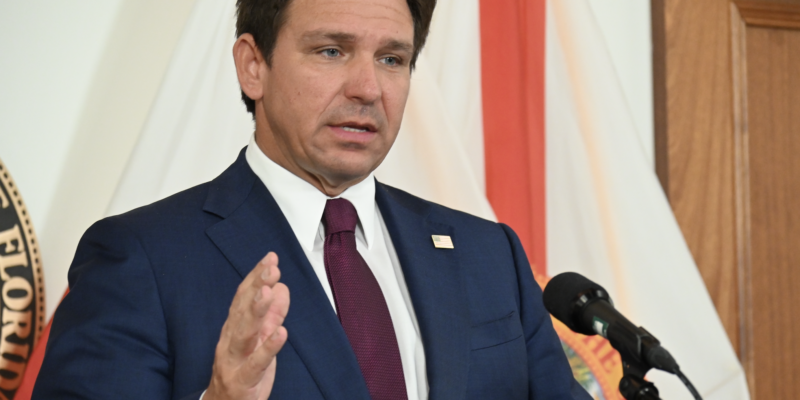

Gov. Ron DeSantis provided an update following record-breaking rainfall across Florida in November while speaking at a press conference alongside state officials in Melbourne.
Melbourne has received over 22.59 inches of rain in November, making it the wettest month on record since August 2008, when 21.06 inches fell largely from Tropical Storm Fay. Melbourne also had nearly 21 inches mainly from Hurricane Irma in September 2017.
“Parts of Florida, including here in West Melbourne, received 15-20 inches of rain in the last week. In response to severe flooding, the State of Florida has been focused on saving lives, supporting residents in need, and keeping critical services available,” DeSantis said in a statement. “State personnel have completed nearly 500 floodwater rescues, and more than 10,000 feet of Tiger Dams have been deployed to protect critical infrastructure. We have established two responder base camps, volunteer villages, and two logistical staging areas to position personnel, equipment, and resources. We are submitting an additional Major Disaster Declaration request to secure federal assistance for communities affected by flooding.”
Parts of Florida, including here in West Melbourne, received 15-20 inches of rain in the last week. In response to severe flooding, the State of Florida has been focused on saving lives, supporting residents in need, and keeping critical services available.
State personnel have… pic.twitter.com/JxwkTmnkEO
— Ron DeSantis (@GovRonDeSantis) November 23, 2026
Gov. DeSantis also noted the St. John's River was at record-breaking levels, with more flooding expected.
"Near Cocoa, the St. Johns River is nearly 19 feet on Saturday, November 21st. That surpasses the previous record by more than a foot. We've also seen areas near Sanford and Deland and Astor see major rising and major water," DeSantis said in Orlando. "The St. John River moves very slowly. Floodwaters could take weeks, or sometimes even months, to recede. Any additional rainfall could worsen the flooding and/or extend the time it takes for water levels to return to normal."
Florida has issued the following response:
- 160 Florida State Guard personnel.
- 421 Florida National Guard personnel.
- 173 law enforcement officers by Floria Fish and Wildlife to impacted communities, including Brevard, Broward, and Volusia counties.
- 73 troopers by Florida Highway Patrol in Brevard County.
- 750 personnel by Florida Department of Transportation in Central and South Florida.
- 90 pumps and 22 vacuum trucks by the Florida Department of Environmental Protection in Brevard, Broward, Indian River, Flagler, Palm Beach, St. Lucie, and Volusia counties.
Florida Division of Emergency Management Executive Director Jared Perdue, Brevard County Sheriff Wayne Ivey, Florida State Guard Director Colonel Mark Thieme, and U.S. Rep. Mike Haridopolos, who thanked the state's public safety team for their response to the storm.
"I was out within the last few days to see the just heroic efforts they're making across our community, going into waste deep water, talking to folks, and making sure they're safe. That's our number one responsibility as the government, protect life and property, and they have done that from day one," Haridopolos said.